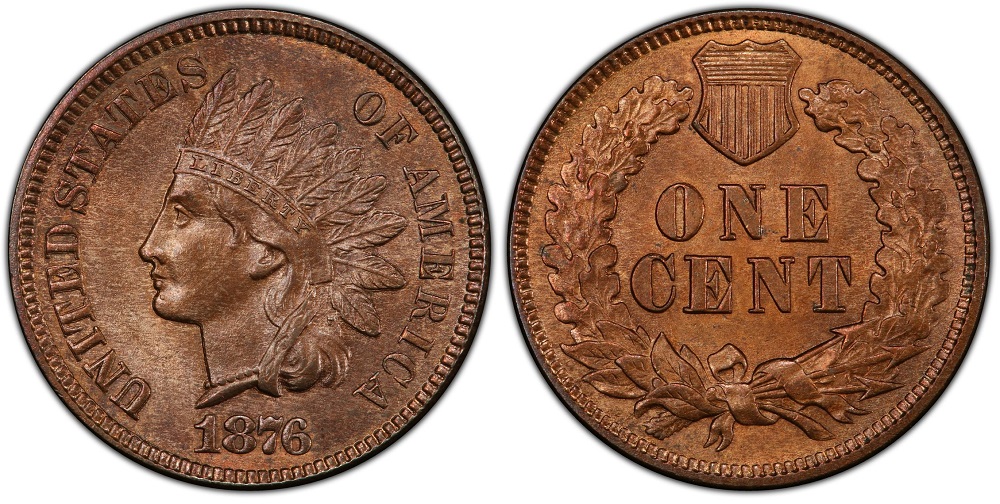
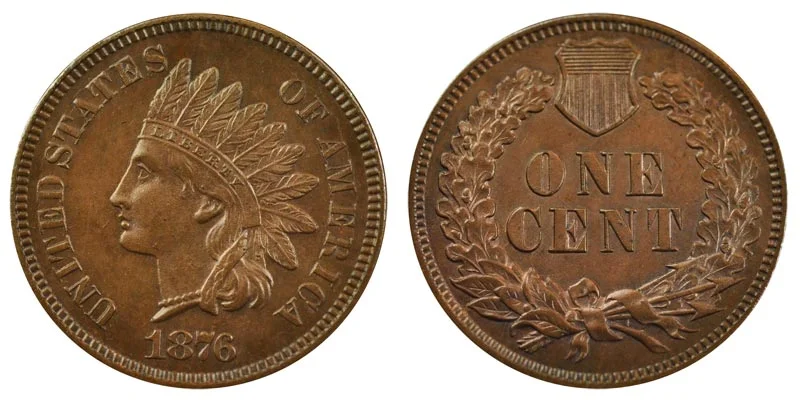
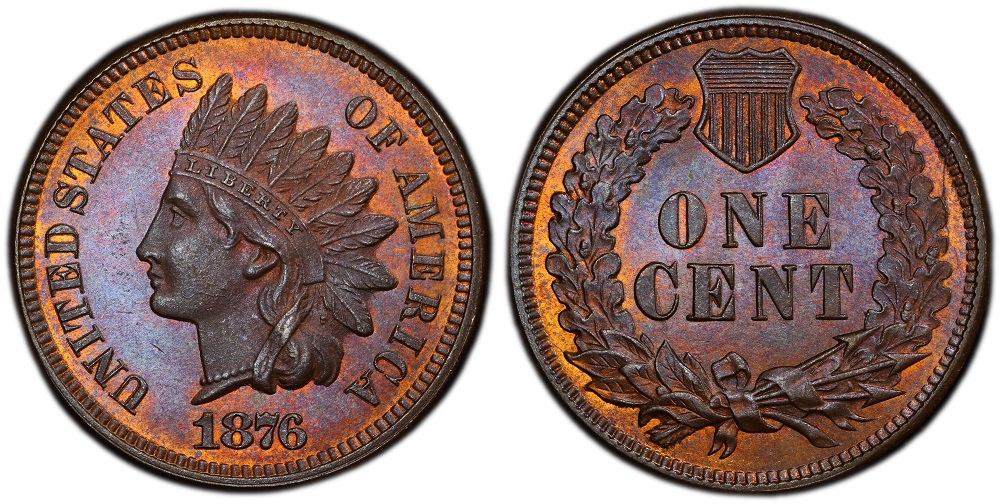
America's Centennial year penny sold for $3,360 in MS66BN at Stack's Bowers in 2025 — yet most worn examples bring $30–$50. Find out exactly where yours falls.
$3,360Top auction sale (MS66BN, Stack's Bowers 2025)
7.94MCirculation mintage — far below most dates
1,150Estimated proof coins struck for collectors
150+Years old — minted in America's Centennial year
Free 1876 Indian Head Penny Value Calculator
Answer the three steps below for an instant estimate based on real market data.
Step 1 — Mint Mark
Step 2 — Condition
Step 3 — Known Varieties or Features
If you are not yet sure about your coin's mint mark, condition, or die varieties, there's a 1876 Indian Head Penny Coin Value Checker tool that uses photo uploads to estimate value automatically — handy if you are just getting started.
Describe Your Coin for a Detailed Assessment
Not sure about the grade or variety? Type what you see in plain English and we'll analyze it.
Mention these things if you can
Date clarity and sharpness
LIBERTY letters — all visible?
Color: red, red-brown, or brown?
Any doubling on the date digits
Raised lines or blobs near rim
Also helpful
Headdress feather detail level
Cheek and ribbon wear
Surface marks or scratches
Any cleaning or shine
Whether it's been certified
Skipped the calculator? Get an instant value estimate in under 60 seconds.
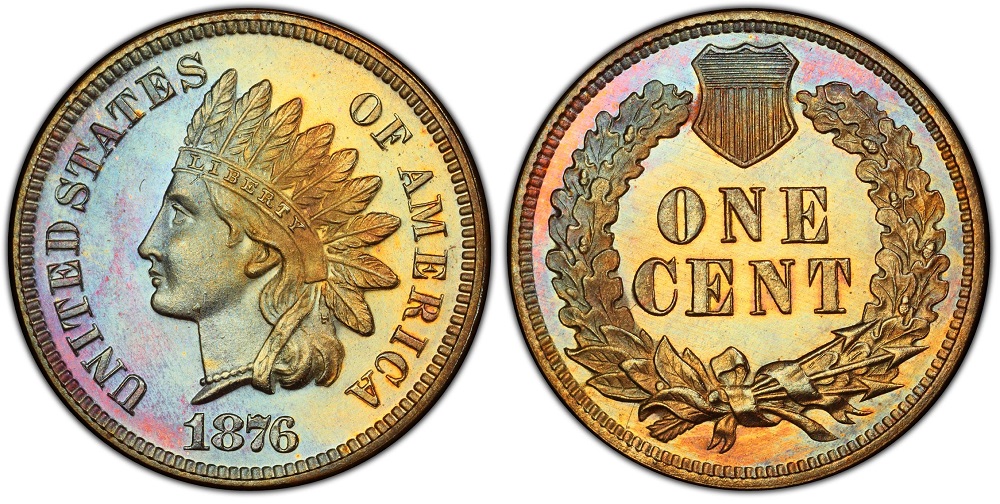
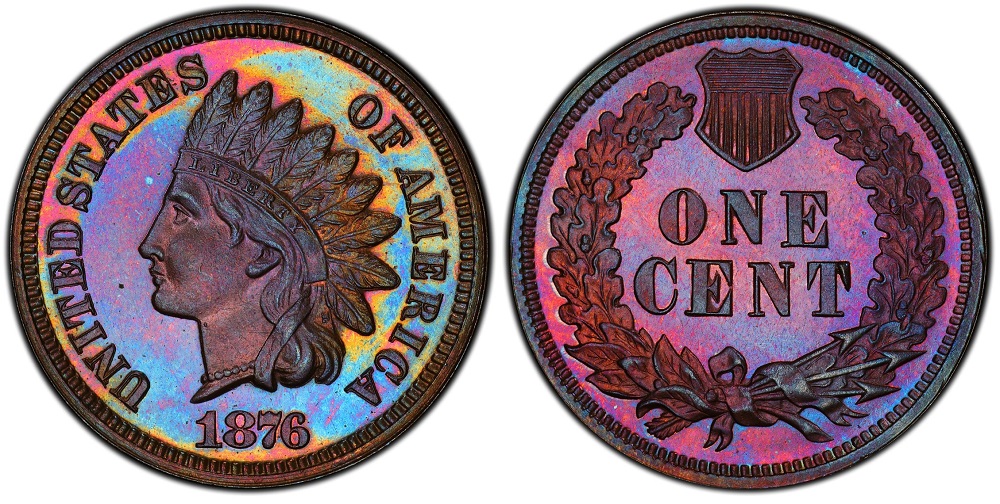
The 1876 proof (est. 1,150 struck) is the most sought-after variety. Use this visual checker to see if you have one.
🔘 Standard Business Strike — Common
Fields have satiny or cartwheel luster (not mirror-like)
Rim is rounded and may show slight softness
Some softness possible on highest design points
Die striations rarely visible in fields
— vs —
✨ Proof Strike — Rare & Premium
Fields are deeply mirrored (cameo contrast on devices)
Rim is sharp, square, and fully formed — no softness
Every design element is fully struck with razor-sharp detail
Die striations may be visible in mirror fields under light
Four-Point Proof Checklist
1876 Indian Head Penny Value Chart at a Glance
The table below summarizes current market ranges across all major varieties and condition tiers. For a detailed step-by-step 1876 Indian Head cent identification walkthrough covering grading nuances and die variety attribution, see this in-depth Indian Head penny guide and reference tool.
Variety
Worn (G–VG)
Circulated (F–EF)
Uncirculated (MS60–63)
Gem MS (MS64–66)
Standard BN — Philadelphia
$30–$65
$80–$280
$300–$475
$720–$3,360+
🌟 Proof Strike (BN–RB)
$200–$320
$320–$600
$600–$1,300
$1,500–$5,000+
Repunched Date (RPD / Snow-1)
$50–$100
$120–$400
$400–$700
$800–$2,000+
🔴 Die Cud Variety
$75–$150
$150–$500
$500–$1,000
$1,000–$3,000+
Original Red (RD) Color
N/A
N/A
$500–$900
$1,800–$5,500+
Major Die Crack
$45–$90
$100–$350
$375–$650
$750–$2,500+
🌟 = Proof variety (highlighted gold). 🔴 = Die Cud variety (highlighted red). Values are market ranges based on recent auction results and dealer pricing as of 2026. Uncirculated RD-color coins are excluded from worn/circulated rows as they do not circulate.
🪙 CoinKnow lets you photograph your 1876 Indian Head penny and instantly cross-reference condition against certified examples — a coin identifier and value app.
The Valuable 1876 Indian Head Penny Errors & Varieties (Complete Guide)
The 1876 Indian Head cent was produced from multiple die pairings, several of which carry collector premiums. Below are the five most significant varieties, ranked by collector demand, with attribution references from the Snow and indiancentvarieties.com systems. Every variety featured here is identified by examinable physical characteristics — a 10× loupe is sufficient for most.
Repunched Date — RPD-001 / Snow-1
MOST FAMOUS$50 – $2,000+
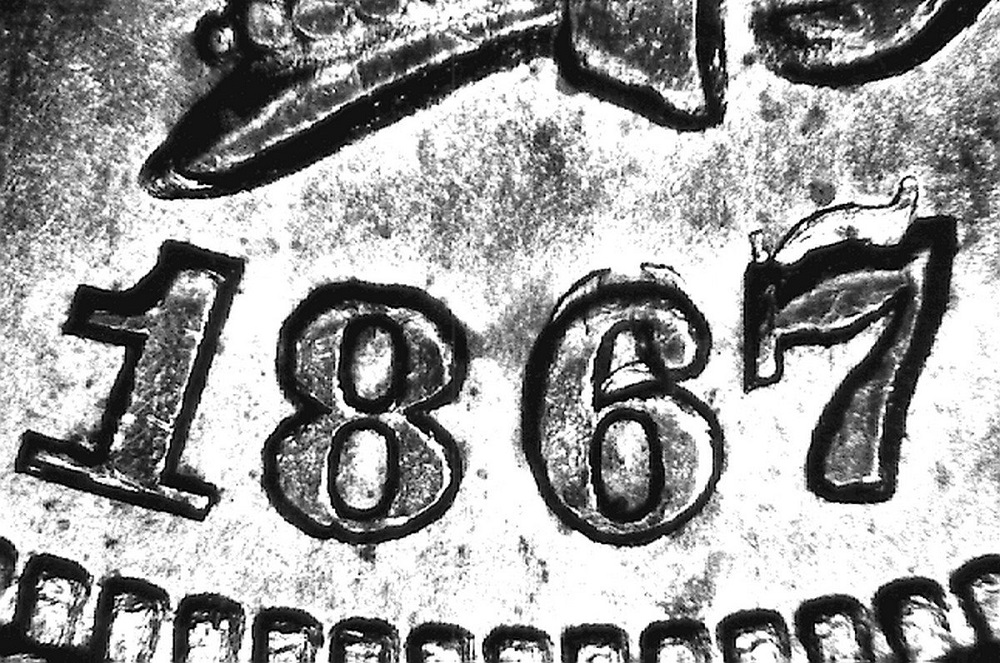
The RPD-001 variety, cross-referenced as Snow-1 and attributed to researcher Quent Hansen, occurs when a date-punch logpunch was applied to the working die twice — with the second impression displaced slightly south of the first. The "18" digits are most dramatically affected, showing clear secondary outlines below the primary numerals.
Visually, look for a ghost-like set of digit outlines lurking just beneath the bottom serifs of the "1" and inside the lower loop of the "8." The doubling is most visible at the base of each affected numeral. A 10× loupe under raking light from the side makes the secondary punch shadow far easier to read than under direct illumination.
Collectors prize this variety because it is the single most identified and publicized die variety for the 1876 date, giving set builders a definitive attribution goal. Demand from both Indian Head cent specialists and general error collectors sustains a persistent premium across all circulated and uncirculated grades, with higher-grade examples particularly sought for registry sets.
How to Spot It
Examine the "18" under a 10× loupe at raking side-light. Look for secondary digit outlines displaced slightly south (toward the rim) of the primary punch. The lower loop of "8" and the bottom serif of "1" show it most clearly.
Mint Mark
Philadelphia only — no mint mark on the coin, all 1876 Indian cents were struck exclusively at the Philadelphia Mint.
Notable
Attributed as RPD-001 by indiancentvarieties.com and Snow-1 in Richard Snow's attribution system. Die pairing: Obverse B with Reverse RH. A significant premium over standard 1876 cents begins even in Good-4 grade for confirmed examples.
Proof Strike — PR63 to PR66 RD
MOST VALUABLE$450 – $5,000+
The Philadelphia Mint struck an estimated 1,150 proof 1876 Indian Head cents using specially prepared dies with polished, mirror-like fields and carefully treated planchets. These were sold directly to collectors at the time — not for circulation — making them intentional collector coins rather than errors or varieties in the traditional sense.
The defining visual signature is the deeply reflective, mirror-like field surface that creates a stark cameo contrast with the frosted, matte-textured portrait and wreath devices. Hold the coin at a low angle to a single light and the fields should flash like chrome. The rim is perfectly squared and fully formed at every point around the circumference with no softness.
Proof 1876 cents are offered in two die varieties (Snow PR1 using a T2 hub obverse paired with a right-hand reverse, and Snow PR2 using the standard obverse paired with Reverse C). RD (Red) proof examples are extremely scarce and command extraordinary premiums. The coin's Centennial significance — struck in 1876, America's 100th year — gives proofs particular appeal to Americana collectors beyond the standard Indian cent specialist market.
How to Spot It
Check the flat field areas with a single directional light. A genuine proof's fields are mirror-like, reflecting clearly. The rim should be fully square and sharp at all points. Contrast between the frosted portrait and mirror field is the critical cameo diagnostic visible without magnification.
Mint Mark
Philadelphia only — no mint mark, proof coins were a Philadelphia Mint exclusive for the Indian Head cent series through its entire production run.
Notable
Snow PR1 uses the rare T2-A hub obverse. An NGC PR66 Red example sold for several thousand dollars at auction. PCGS Condition Census shows the top proof examples at PR66RD, population extremely limited — just 3 coins at that grade per historical population reports.
Reverse Cud — Die Break Variety (Variety 3)
RAREST STRIKE$75 – $3,000+
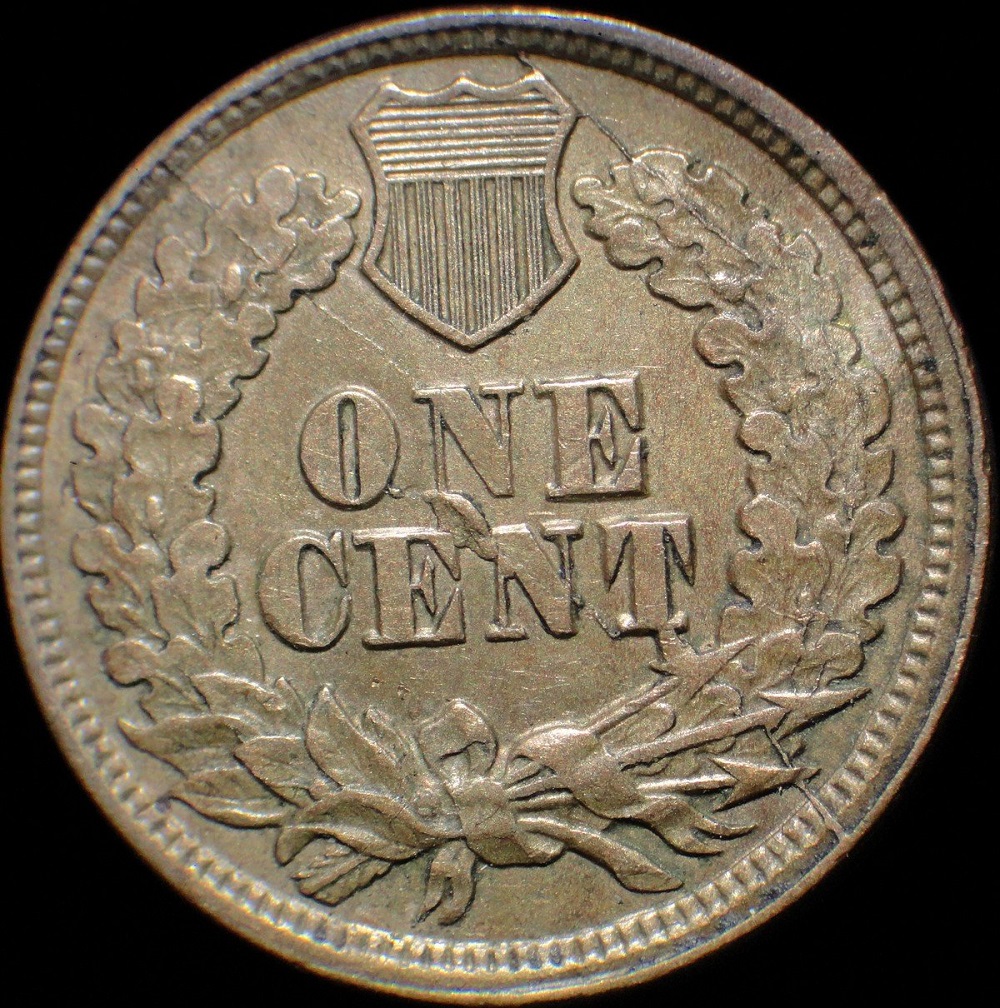
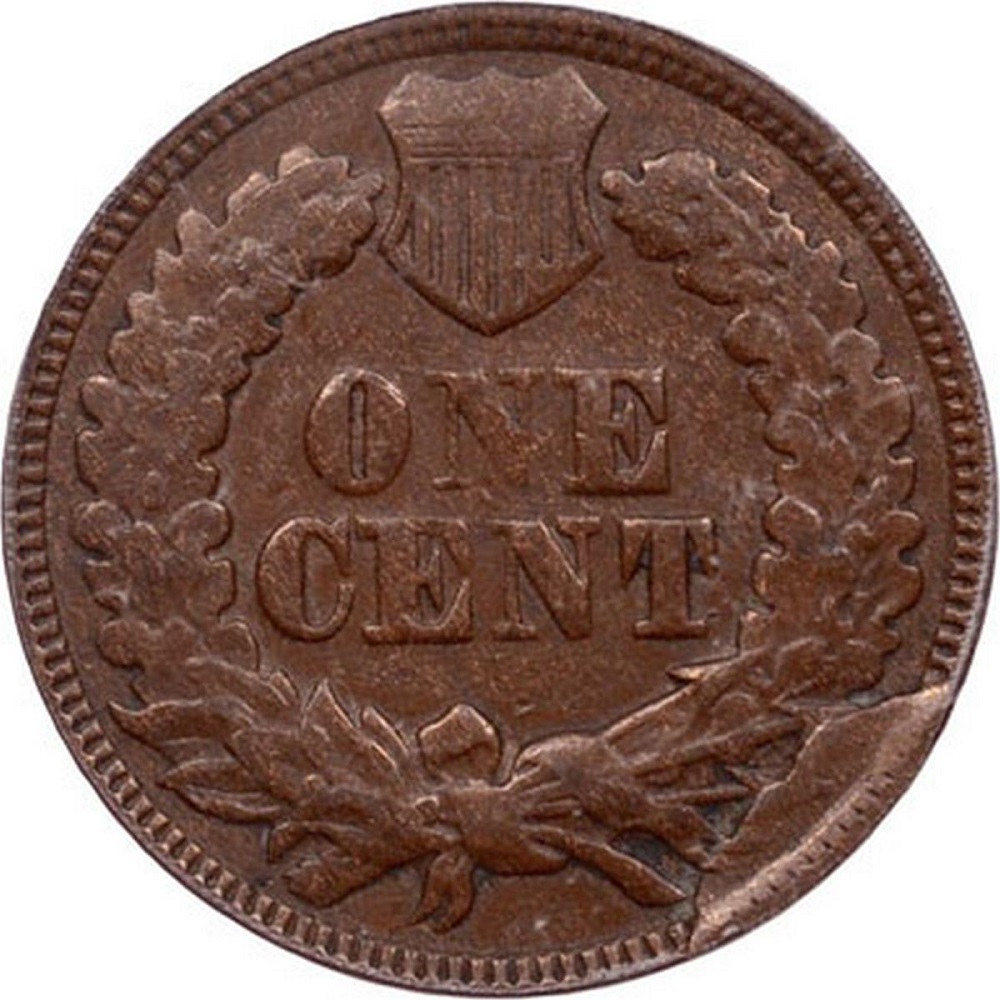
The die cud on the reverse of the 1876 Indian Head cent (Variety 3, Obverse D × Reverse LH pairing) formed when a section of the reverse working die physically broke away during production. With that die segment missing, metal flowed freely into the void during the strike, forming a raised, irregular blob — the cud — at the rim between approximately the 2:00 and 3:30 clock positions.
The cud presents as a smooth, lumpy raised mass at the rim that obliterates the design detail in that sector. Adjacent die cracks emanating from the break are often visible on properly preserved examples. The Obverse D die used in this pairing also exhibits an artifact below and to the right of Liberty's nose on some examples, providing an additional diagnostic for attribution.
Die cuds are among the most visually dramatic of all mint errors and attract a broad collector base beyond Indian Head cent specialists — any die-error collector regards a cud coin as a significant find. The 1876 reverse cud is particularly scarce in higher circulated grades, as the prominent raised mass made the coins obvious to commerce and many were culled or set aside over the decades.
How to Spot It
Examine the reverse rim area between 2:00 and 3:30 clock positions with naked eye or loupe. A genuine cud appears as a smooth, raised, irregular mass merging seamlessly with the rim — not a stuck-on object but an integral part of the struck metal. Compare die-crack lines radiating from the cud boundary.
Mint Mark
Philadelphia only — no mint mark. This cud die pairing is Obverse D with Reverse LH, classified as Variety 3 in the indiancentvarieties.com system.
Notable
Cross-referenced as Variety 3 in the definitive indiancentvarieties.com attribution system. The Obverse D die shows a diagnostic artifact below-right of Liberty's nose. Die cud coins consistently attract a premium of 50–150% over standard 1876 cents at the same grade level, confirmed across multiple Heritage and eBay completed sales.
Die Rust / Lint Hub-Through — Variety 4
BEST KEPT SECRET$55 – $1,500+
Variety 4 (Obverse A.2 × Reverse RE) is one of the most diagnostically rich 1876 die pairings. The obverse working die developed localized rust during storage or after several strikes, leaving a granular, pitted texture within the second headdress feather, in the hair between the first curl and Liberty's ear, and on her chin. Rust on a working die transfers as raised, bumpy texture to coins struck while the die deteriorates.
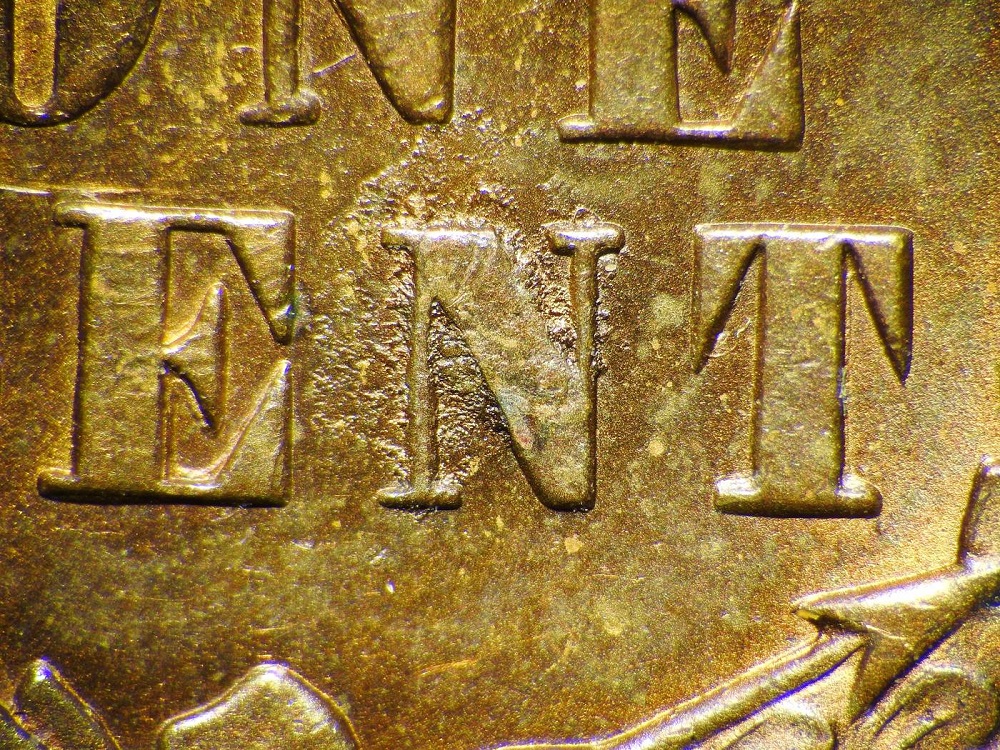
The reverse RE die shows a chip in the upper portion of the diagonal of the N in CENT, along with die cracks connecting the tops of "OF AMERICA" and "UNITED STATES." The obverse exhibits die cracks between 11:00 and 1:00 and within both wreath branches, and lint hub-through marks appear as shallow incuse channels within the denticles between the 9:30 and 10:00 clock positions.
Lint hub-throughs occur when a fiber or debris particle lodges in the hub before the working die is made — the fiber blocks metal flow at that spot, creating a raised thread-like impression on the hub and a corresponding incuse channel on the die and ultimately on struck coins. The combination of die rust, lint hub-throughs, and multiple die cracks on Variety 4 makes it one of the most collectible and attributable 1876 die pairings despite not being the most expensive individual variety.
How to Spot It
Under a 10× loupe, examine Liberty's second headdress feather for a rough, granular surface texture contrasting with the smoother first feather. Check denticles near 9:30–10:00 for shallow incuse thread-like channels. Die cracks connecting the tops of AMERICA and UNITED STATES on the reverse confirm attribution.
Mint Mark
Philadelphia only — no mint mark. Obverse A.2 paired with Reverse RE. This pairing is cross-referenced as Variety 4 (die pairing number 3.2 in the emission sequence analysis).
Notable
The die chip on the N diagonal in CENT (Reverse RE) is a fully confirmable diagnostic under 10× magnification. Varieties with documented lint hub-throughs are noted in the indiancentvarieties.com definitive reference. This variety's multi-diagnostic richness makes it especially popular with advanced Indian cent specialists.
Partial Cud & Multi-Die-Crack — Variety 2
SPECIALISTS' CHOICE$60 – $2,000+
Variety 2 (Obverse C × Reverse C) is distinguished by a dramatic constellation of die failures on both the obverse and reverse, making it arguably the most die-deterioration-advanced of all 1876 circulation strike pairings. The obverse die shows major die cracks radiating from the 4:30, 7:00, and 9:00 clock positions — visible to the naked eye on well-preserved examples as raised lines crossing the field.
The reverse die suffered a partial cud between the 8:15 and 9:00 clock positions, where the die partially broke away, creating a raised irregular blob of metal in that sector of the coin. Additionally, the reverse shows die cracks at 12:45, 5:15, and 11:30, and lint hub-throughs within the denticles between 9:30 and 10:00 — a nearly identical hub-through zone to that seen on Variety 4, suggesting a shared hub source.
Collectors of die-deterioration sequences prize Variety 2 because it represents one of the most advanced stages of die life documented for any 1876 pairing, with both dies simultaneously showing significant failure. Coins struck from heavily deteriorated dies like this carry a premium in the specialized die-variety market, as survivors with visible, sharp die-crack definition across all documented positions are genuinely uncommon even within an already semi-key date.
How to Spot It
Scan the obverse under single-source light for raised lines at 4:30, 7:00, and 9:00. On the reverse, check the 8:15–9:00 zone for a smooth partial cud. Lint hub-throughs in the reverse denticles near 9:30–10:00 can be confirmed with a 10× loupe as incuse thread-channels.
Mint Mark
Philadelphia only — no mint mark. Obverse C paired with Reverse C, listed as Variety 2 (die pair number 5 in the emission sequence) in the indiancentvarieties.com reference.
Notable
The simultaneous presence of a partial cud, three obverse die cracks, three reverse die cracks, and lint hub-throughs makes this variety uniquely attributable at multiple confirmation points. Listed in the indiancentvarieties.com definitive reference. Advanced examples with well-defined die cracks at all documented positions are especially prized by specialists.
Found one of these varieties on your coin? Get a value estimate right now.
Semi-key date; most other bronze Indian cents struck 13M–80M+
🌟 Proof Strike (PR)
Philadelphia (P)
~1,150 (est.)
Sold directly to collectors; two die pairings (Snow PR1 and PR2)
Total
Philadelphia only
~7,945,150
No branch mint coins; no San Francisco or Carson City issue
Composition & Specifications
Metal: 95% Copper, 5% Tin & Zinc (Bronze)
Weight: 3.11 grams
Diameter: 19.00 mm
Edge: Plain (smooth)
Designer: James Barton Longacre
Melt Value: ~$0.04 (negligible)
Survival context: PCGS CoinFacts notes that probably no more than a few thousand 1876 Indian Head cents survive in uncirculated grades, with MS66-quality examples numbering perhaps only a few dozen. The coin's semi-key status relative to the common-date Indian cents (which often exceed 50 million coins struck) means demand consistently exceeds available supply at all grade levels, supporting premiums even in heavily worn condition.
How to Grade Your 1876 Indian Head Penny
Worn / Good (G–VG)
$30–$65
Heavy wear has smoothed the headdress feathers and cheek. Date and LIBERTY are legible but flat. The coin's outline is visible; most fine detail is gone. Still a recognized semi-key date coin with meaningful collector demand.
Circulated (F–EF)
$80–$280
Fine: All LIBERTY letters visible, feather bases showing. Extremely Fine: Only slight wear on the highest design points — diamond on ribbon, cheekbone, tips of headdress feathers. Most detail sharp and clear throughout.
Uncirculated (MS60–63)
$300–$475
No wear at all. Full cartwheel luster under rotating light. Contact marks from the bag (bag marks) are acceptable at MS60–62. At MS63, marks are fewer and less distracting. Color is typically BN or RB at this level.
Gem MS (MS64–66+)
$720–$3,360+
Minimal contact marks, above-average eye appeal. MS65 shows only very light marks visible to the naked eye. MS66 is nearly mark-free with outstanding luster. RD color coins at this level are extremely rare and command significant premiums above BN values.
Pro Tip — Color Designation: For uncirculated 1876 Indian Head cents, color is critical to value. BN (Brown) coins with original chocolate-brown toning are the most common uncirculated survivors. RB (Red-Brown) coins retaining at least half their original copper-red surface carry a meaningful premium. RD (Red) examples with 95%+ original red are genuinely rare for this date and can double or triple the value of an equivalent BN specimen at the same MS grade. Never clean a coin attempting to restore color — cleaned coins are drastically discounted by dealers and grading services.
🔍 CoinKnow can match photos of your 1876 Indian Head penny against certified graded examples to help you compare condition before submission — a coin identifier and value app.
Where to Sell Your Valuable 1876 Indian Head Penny
Your sale venue should match the grade and value of your coin. A $30 worn example sells best locally; a $1,000+ gem merits a major auction house.
🏆 Heritage Auctions / Stack's Bowers
The top two U.S. numismatic auction houses consistently achieve strong results for semi-key Indian Head cents. The $3,360 MS66BN result came from Stack's Bowers. Best for MS62 and above, or any proof example. Expect a seller's commission but wider bidder reach than any other channel.
🛒 eBay Completed Listings
eBay is the most transparent market for 1876 Indian Head cents. Review recently sold 1876 Indian Head penny prices and completed listings before setting your asking price. Certified (PCGS/NGC) coins sell significantly higher than raw examples. Best for circulated and lower-grade uncirculated examples.
🏪 Local Coin Shop (LCS)
A local dealer offers immediate payment with no listing fees or wait time. Expect to receive 50–70% of retail value for circulated coins and 60–75% for certified examples. Useful for worn examples where auction fees would eat most of the profit. Always get at least two dealer opinions before accepting an offer.
💬 Reddit r/coins & Collector Forums
Online collector communities like Reddit's r/coins, r/coincollecting, and dedicated Indian cent forums attract knowledgeable buyers who pay fair prices. Best for circulated certified examples where you want to avoid dealer spreads. Requires patience and a good understanding of how to photograph and describe your coin accurately.
💡 Get It Graded First: Any 1876 Indian Head penny you believe grades AU50 or higher should be submitted to PCGS or NGC before selling. The certification fee (typically $30–$50 for standard service) is recovered many times over on a genuine high-grade example. A raw MS62 might bring $350; the same coin in a PCGS or NGC holder regularly brings $449 or more based on recent completed sales. For proof examples, certification is essentially mandatory to realize full value.
Frequently Asked Questions
How much is a 1876 Indian Head penny worth in good condition?
A 1876 Indian Head penny in Good (G-4) condition is typically worth around $30–$50 based on current market data. Despite heavy wear, this semi-key date commands a premium because its mintage of 7,944,000 was much lower than most other Indian Head cent dates. Even well-worn examples are sought by date collectors completing full sets. Values fluctuate with the coin market, so check recent sales before buying or selling.
What makes the 1876 Indian Head penny a semi-key date?
The 1876 penny is classified as a semi-key date because its mintage of 7,944,000 is dramatically lower than common-date Indian Head cents, which often exceeded 50–80 million pieces. Struck during America's Centennial year, the coin saw heavy circulation. Over 150 years of attrition means far fewer survive in collectible grades than the original mintage implies, pushing premiums across all condition tiers.
What is the highest recorded sale for a 1876 Indian Head penny?
The highest publicly documented auction record for a regular-strike 1876 Indian Head penny is $3,360 for an MS66BN example sold at Stack's Bowers in April 2025. An MS66 RB example sold at Heritage Auctions in January 2026 for $2,806. Proof examples graded PR65 or PR66 RD are significantly rarer and can exceed those figures, though specific recent sale prices for top proof specimens are less frequently published.
Were any 1876 Indian Head pennies made as proof coins?
Yes. The Philadelphia Mint produced an estimated 1,150 proof 1876 Indian Head cents for sale to collectors. These proofs feature deeply reflective mirror-like fields and sharp, squared rims. They were struck in bronze with the same 95% copper, 5% tin and zinc composition as circulation strikes. Proof examples are highly sought by specialists and command substantial premiums over their business-strike counterparts in equivalent numerical grades.
What does the color designation BN, RB, or RD mean on a 1876 penny?
For bronze Indian Head cents, PCGS and NGC append a color suffix to uncirculated grades: BN (Brown) means the coin has lost most of its original red copper luster; RB (Red-Brown) means at least half the original red color is retained; RD (Red) means 95% or more original mint red survives. A 1876 RD example is far scarcer than a BN one at the same numerical grade and commands a significant premium — sometimes two to three times the BN value.
How do I spot the 1876 Repunched Date (RPD) variety?
The most collectible 1876 die variety (Snow-1 / RPD-001) shows visible remnants of an earlier date punch beneath the final '18' digits. Examine the date numerals under a 10× loupe at a low raking angle. You should see a secondary set of digit outlines slightly south of the final '18.' The doubling is most apparent on the bottom serifs of the '1' and the lower loop of the '8.' A clean coin in any circulated grade showing this feature carries a meaningful premium.
Is the 1876 Indian Head penny a good investment?
The 1876 Indian Head penny has historically held and grown in value because of its semi-key status, Centennial year significance, and appeal to both type collectors and date-set builders. High-grade (MS64 and above) and RD-designated examples have shown strong auction performance. As with any numismatic investment, condition is everything — buying the highest-grade, problem-free coin your budget allows and having it professionally certified (PCGS or NGC) reduces risk.
What should I look for when buying a 1876 Indian Head penny?
Focus on problem-free surfaces — avoid coins with cleaning, corrosion, scratches, or altered color. The headdress feathers, diamond on the ribbon, and cheek are the first areas to wear; sharp detail in those zones signals a higher grade. Buying PCGS or NGC certified coins eliminates authentication risk. For circulated examples, look for strong LIBERTY letters in the headband. For uncirculated coins, prioritize RB or RD color designations and minimal contact marks on the fields.
What composition is the 1876 Indian Head penny?
The 1876 Indian Head cent is struck in bronze: 95% copper with 5% tin and zinc. It weighs 3.11 grams, measures 19 millimeters in diameter, and has a plain (smooth) edge. The coin was designed by James Barton Longacre, the fourth Chief Engraver of the U.S. Mint. The bronze alloy replaced the earlier copper-nickel composition in 1864, giving the coin a warmer, reddish-brown appearance that deepens to chocolate brown over decades of toning.
Where can I sell my 1876 Indian Head penny for the best price?
For high-grade or certified examples (MS62 and above), Heritage Auctions and Stack's Bowers consistently achieve strong prices. eBay's completed-listings tool shows real-time market demand. Local coin shops offer immediate cash but typically at wholesale prices. Online collector forums like Reddit's r/coins provide exposure to knowledgeable buyers. Always get at least two price opinions before selling, and consider professional grading for any coin you believe grades MS60 or higher.
Ready to find out what your 1876 Indian Head penny is worth?
Use our free calculator — takes under 60 seconds. No signup required.